Eight-Treasure Congee
Làbā Zhōu (腊八粥)
Eight-Treasure Congee is one of China’s most culturally meaningful winter dishes. Eaten on the Laba Festival: traditionally the day the Buddha attained enlightenment. It began as a ceremonial porridge offered in temples before becoming a cherished household food. Families make it from whatever grains, beans, seeds, and dried fruits they have on hand, each ingredient symbolizing blessings for the coming year: abundance, health, harmony, and longevity. Despite its festive origins, this porridge is also a nourishing winter breakfast, warming the body slowly and providing sustained energy during the coldest time of year.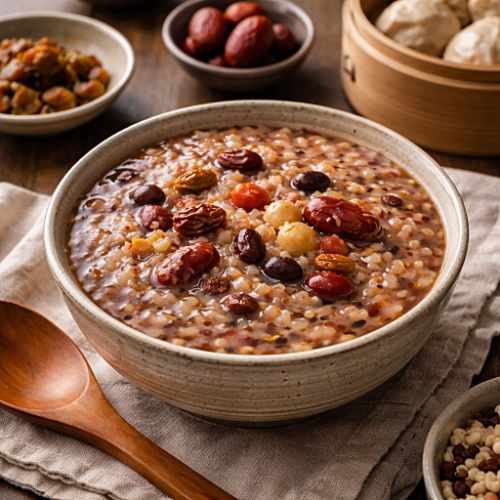
What makes this dish worth learning? This congee teaches the principle of slow nourishing tonics, where warmth, time, and whole ingredients build comfort rather than richness or spice. It demonstrates how multiple grains and legumes can harmonize into a smooth, gently sweet porridge. Mastering this recipe opens the door to countless congee variations—savory, sweet, winter, or summer.
Ingredients: (Serves 3–4)
Traditional versions contain many items, but this simplified edition uses ingredients accessible in most U.S. supermarkets:
- ½ cup white rice (short-grain preferred)
- ¼ cup rolled oats or barley
- 2 tbsp mung beans or lentils
- 2 tbsp sweet rice (optional)
- 2 tbsp peanuts or walnuts
- 2 tbsp raisins or chopped dried fruit
- 1–2 tbsp goji berries (optional)
- 6–7 cups water
- 1–2 tbsp rock sugar or a small amount of brown sugar (optional)
Notes on accessibility: If items like mung beans or sweet rice are unavailable, simply increase the rice and oats. Eight treasures is symbolic because your “treasures” can be whatever grains and nuts you enjoy.
Instructions:
Rinse the grains and beans lightly. Combine all ingredients except dried fruit and goji berries in a large pot with the water. Bring to a boil, then reduce to a low simmer.
Cook uncovered for 1–1½ hours, stirring occasionally to prevent sticking. Add water as needed to reach your desired consistency.
In the last 10 minutes, stir in raisins or dried fruit. Add sugar only if you prefer a slightly sweet congee.
Continue simmering until everything softens into a smooth, creamy porridge. Serve warm.
Substitutions and Variations:
If you prefer a richer flavor, add a splash of coconut milk at the end (not traditional, but pleasant).
For a heartier version, stir in chopped red dates or, if accessible, lotus seeds.
Oats and barley make excellent Western supermarket substitutes for traditional millet and sorghum.
Health and Culinary Notes:
In TCM, winter is a time to nourish the kidneys, warm the center, and store energy. Mixed-grain congees are considered excellent for this purpose: warming, stabilizing, easy to digest, and mildly tonifying. Nuts support Qi and blood, while dried fruits moisten dryness, important during winter’s cold, dry air. Laba congee is both a cultural blessing and a form of gentle seasonal medicine.