Tai Chi as a Bridge Between
Exercise and Therapy
Tai Chi occupies an unusual place in modern healthcare. It is practiced as a martial art, a form of exercise, a meditative discipline, and increasingly as a supportive therapy. The same slow movements may appear in a traditional school, a community recreation program, a senior center, or a rehabilitation clinic.
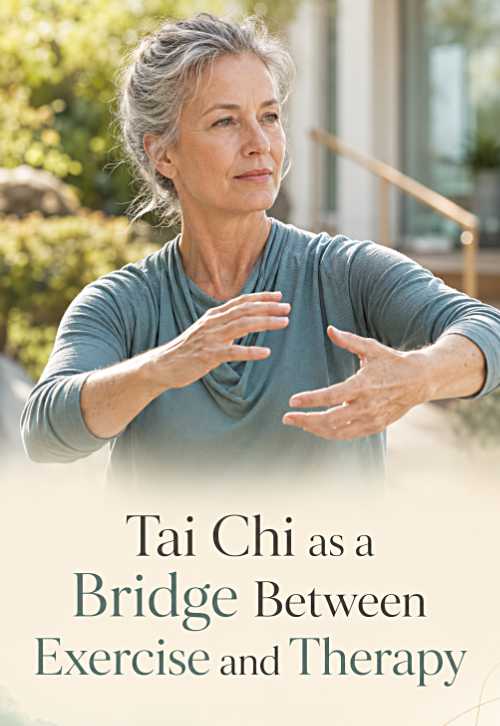 This flexibility is one reason Tai Chi (also spelled Taiji or Taijiquan) can serve as a bridge between ordinary exercise and therapeutic movement.
Exercise is usually described in terms of strength, flexibility, endurance, and balance. Tai Chi develops these qualities, but it does so through coordinated whole-body movement. Weight shifts gradually from one leg to the other. The body turns while maintaining alignment. The arms and legs move in relationship rather than as isolated parts. Attention, breathing, posture, and intention remain connected throughout the practice.
These qualities resemble some of the goals of physical and occupational therapy. A person recovering from illness or managing a chronic condition may need to relearn how to shift weight confidently, turn without losing balance, rise and settle smoothly, or coordinate movement with breathing. Tai Chi places many of these skills within continuous, meaningful sequences.
Research has focused particularly on balance and fall prevention. The National Center for Complementary and Integrative Health reports that Tai Chi may improve balance and stability and reduce falls among older adults. Studies also suggest possible benefits for people managing knee osteoarthritis, back pain, fibromyalgia, Parkinson’s disease, and certain other chronic conditions. The strength of the evidence varies, and Tai Chi should not be presented as a cure.
Its therapeutic value is not limited to measurable physical changes. People who have experienced pain, injury, or a fall may begin to distrust their bodies. They move cautiously, reduce activity, and gradually lose more strength and confidence. Slow, carefully adjusted practice can provide a safe setting in which to explore movement again.
Tai Chi also asks the practitioner to pay attention without constantly judging performance. This combination of concentration and relaxation may help reduce the tension and anxiety that often accompany persistent symptoms. Simply learning that movement can feel pleasant again may be an important part of recovery.
However, an ordinary Tai Chi class is not automatically therapy. Traditional postures may be too low, movements may be taught too quickly, and an instructor may not understand a participant’s medical limitations. Someone recovering from surgery, experiencing dizziness, or living with significant joint, neurological, or cardiovascular problems may need guidance from a healthcare professional and an instructor experienced in adapting the practice.
Adaptation does not make Tai Chi less authentic. A higher stance, smaller step, supported posture, or seated version can preserve important principles while meeting the student’s present abilities. The objective is not to imitate an idealized performance but to improve the quality and confidence of movement.
Nor should Tai Chi be reduced entirely to therapy. It remains a traditional martial art with a rich cultural history and a sophisticated understanding of balance, timing, structure, and coordinated force. Even when practiced for health, those principles give the movements coherence and purpose.
Tai Chi fits complementary care because it does not need to replace medical treatment, physical therapy, medication, or other appropriate exercise. It can work beside them. A physician may identify the condition, a therapist may address a specific limitation, and Tai Chi practice may help carry improved movement into daily life.
It is exercise, but it can be more attentive than a routine workout. It can be therapeutic, but it is more than a collection of corrective movements. Tai Chi stands between these categories, offering a practical way to transform rehabilitation into an ongoing practice of health.
Source: National Center for Complementary and Integrative Health: Tai Chi.